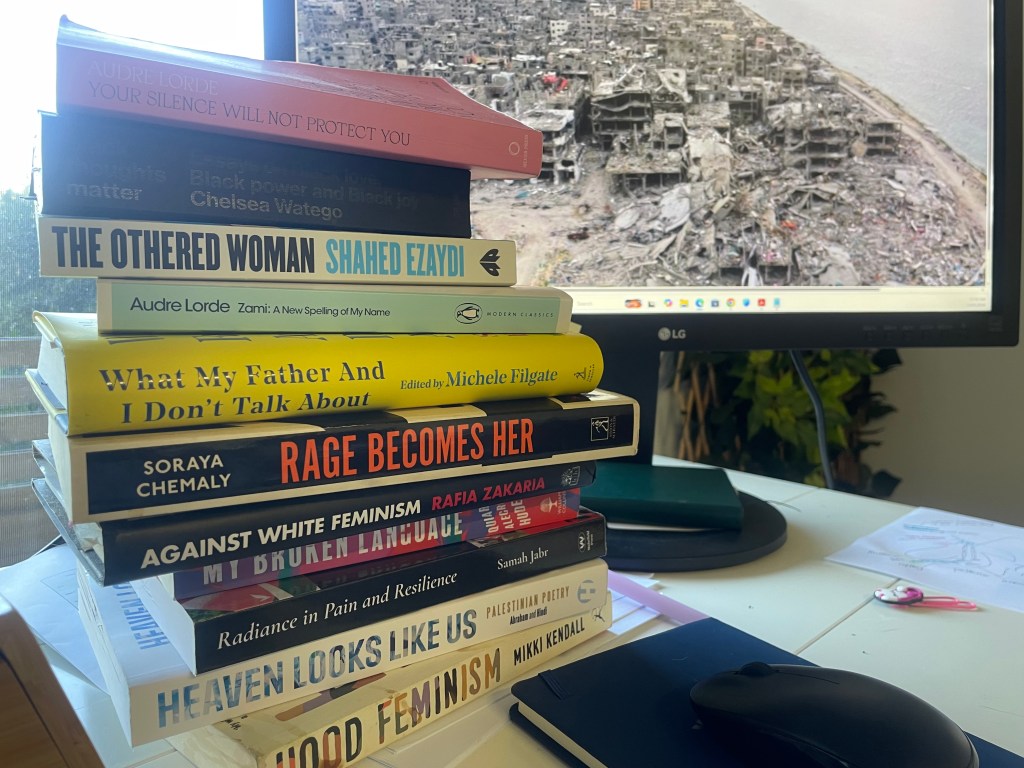
This below piece has been made thanks to recent books I’ve read, by black and coloured folks who have gone through this phase of shedding, and the impact of grief. Grief, when transformed, can be a powerful teacher that will ask you to return to yourself.
I grieve the recent unexpected loss of my father, my grandfather, and the aunt who has given me my rare name. I grieve memories of performing CPR on her and watching as she laid unwell while we waited for the Code Team to arrive. I grieve the years I have lost myself to whiteness, and the many ways I have erased myself to rub shoulders with white women. I grieve the genocide and ethnic cleansing of my brothers and sisters. I grieve as I watch the Naarm scene unaffected the day Beirut was attacked by over a hundred bombs in ten minutes. I grieve West Asia being obliterated every day and watching my white friends defend white supremacy. I watch whiteness ask me to lose myself in semantics, when Arab and Muslim lives are killed every day. I grieve every day.
What do I do with this grief?
I resist whiteness, I wear gold like my grandmothers have, I eat with my hands as white women say eww as they watch me, I wear oud and bakhour every day, I do not straighten my hair anymore, I do not date white folks anymore, I befriend coloured folks at work and stay away from white women obsessed with power, I go to coloured dentists, GPs, and healthcare providers. I go to a gym predominantly attended by Muslim and Arab women. I avoid spaces with majority white folks, and I have realised that my anxiety has been a reaction to their colonial imperial scent. I am loud, funny, giggly, and my body is expansive in coloured folks’ spaces. The system makes you believe you’re the problem when you resist it.
*
Do you solemnly swear that you will tell the truth, the whole truth, and nothing but the truth?
I enjoy weaving the sworn testimony into my everyday life, because I know how easy it is to justify things, minimise harm, and turn a blind eye to maintain something that no longer exists, because naming it would burst the facade.
*
I started to notice patterns that I could no longer unsee, the way proximity to me, to my struggle story, to my warmth, could be something that was enjoyed, even admired, the way my Khaleeji Arab generosity and openness could be perceived as something expansive and interesting, something that allowed others to feel close to coloured folks without being unsettled by it, and how that sense of camaraderie would hold for a time, until it didn’t.
The system isn’t upheld solely by the police and the government. The system is upheld by all white colonisers, every day.
Do you separate yourself from white racists?
Anti-racist work starts through the admission that you are racist.
You are no different to the outright racist, you just have different techniques of upholding the same structures that protect the both of you.
Audre Lorde often expounds on the importance of identifying ourselves, before our enemy identifies us, and we end up carrying the colonial identity of ourselves within our psyche. I stopped identifying myself for a while, but I identify myself often now. Moving through this colony, I understand it is imperative for a coloured woman with a story such as mine, one weaved through survival, freedom fighting, bravery, pain, and a tenacious will to build a better life, will shape and influence many of my relationships. It is imperative for a coloured woman to recognise her beauty, wisdom, confidence, and passionate outspokenness will create an entangled dance where white women will attempt to control the script of what a brown woman should behave and act like. I learnt this from being in community with white women for many years, and witnessing the same script unfolding before my eyes.
Because at some point, I would become something else in the dynamic, not just a friend, but an uncomfortable mirror and a challenge to their preconceived notions of Arab women. It is often in that shift that something subtle begins to happen, something that is difficult to name in the moment, small comments, slight dismissals, humour that carries an edge. Interactions that leave behind a residue of confusion, and I have learnt to pay attention to that confusion, as it is rarely accidental.
For a long time, I would sit with that feeling and try to make sense of it, tracing it back through someone’s upbringing, their past, their insecurities, trying to understand them in order to preserve the relationship, but I do not do that anymore. There are questions I return to now,
What is this person trying to do?
Are they connecting with me or are they trying to dominate me?
The two questions have simplified things both in my personal and professional life, especially as I continue navigating the complex clinical and political space of progressing my career in intensive care nursing. In the ICU, I am required to make sense of situations quickly, to recognise patterns before they fully form, to respond to what is happening in front of my eyes without becoming lost in speculation, and I have realised I can afford myself that same clarity in my relationships.
Losing a parent has a way of accelerating this kind of clarity, of stripping away the patience you once had for dynamics that require you to shrink yourself to maintain them.
*
I’ve been thinking a lot about what it means to share a meal with someone. In my homeland, uncles, aunts, cousins, and grandparents sit with our legs folded around the suffra and eat from one big silver plate. Rice passed through hands, dagous smeared between fingers, pieces of lamb torn and offered around the circle, conversations overlapping and moving in different directions, and even in the chaos of it, there is an attentiveness, a way of ensuring that no one is left out of the experience.
We say,
لا تأكل مع عدوك خبز وملح
do not eat bread and salt with your enemy
I am from a tribe, so we are suspicious and wary, and poison in a meal may not always be literal, it can be the spirit of the other soul impacting the food. Two dinners come to mind.
*
Scene One
I’m hungry and firing suggestions of things to share. We are in an Arab fusion restaurant, colourful hanging lanterns casting warm shadows across the table, the walls adorned with paintings of desert dunes, and the air thick with the smell of cardamom and freshly brewed Arabic coffee. A plastic suffra covers our table beneath blue ceramic bowls of glistening Levant olives placed between us.
I always crave comfort food when I’m hungry. Things that feel nostalgic and familiar so I suggest tabbouleh salad. She pauses, scanning the menu, taking a long time to reply.
She tells me she’s never had it, that there are more interesting salads in the menu, that she never goes for basic salads like that. It is then that I look up, my eyes waiting to meet her gaze, but she never looks away from the menu, as though the conversation is occurring somewhere else.
It is then that I notice how our bodies are folded around the table, I am sitting upright across from her, my shoulders rolled back, hands moving as I speak, my face shifting with expression, offering myself to her. She is sitting lower on her chair, shoulders curved to the side, as though waiting to exit, her face inscrutable, lips barely moving as she speaks, and eyes never quite meeting mine, as though something is being contained between us.
She asks about the white man I was briefly seeing, whether I’ll continue dating him now that I’m back in melbourne, and I tell her no, that he was sweet in a way that felt easy and uncomplicated, but he had no passion, no drive, no real sense of direction, that he worked a menial job and seemed content to remain there, and I cannot built a life with someone like that.
She smirks and there is something fleeting in her expression as she squints her eyes, and she says, ‘didn’t you just say that you couldn’t wait to retire and you’re not excited about working again.’
The hairs on my arms raise, as though a breeze has passed, but rather an unavoidable clarity confronts me then, of something that has been quietly sitting between us for years now.
This white woman, who knows my ins and outs, who has heard my struggle story, sits across from me with a kind of structural ease that has never required the same urgency or bravery that my life has demanded. It is here that I understand that this is beyond a simple misunderstanding, but something more layered and nuanced, something that emerges when two lives shaped under vastly different conditions are brought into proximity.
Because what does it mean to sit across someone who has had access to the very security you have spent decades trying to secure, and to feel, in some quiet way, that your desire for rest is minimised and scorned?
I do not say this. I let it remain between us, unspoken, even as I feel it settle into the space we are sharing. A crack in the facade is heard in the distance, for the ever observant one.
I move on, skimming through the main meal section and suggest mandi, holding my breath as I anticipate her response. She tilts her head as her lips tighten before trailing into a vague comment about the restaurant having more flavourful rice dishes than just bland mandi. It continues like this, every suggestion gently redirected, not sharply enough to be confronted, but consistently enough that an undeniable pattern begins to take form.
I hear myself saying I’m easy, that I am happy with whatever she likes, and even as I say it, I am aware of what I am doing, of how quickly I move on to accommodating, easing tension, smoothing the atmosphere of an interaction, because I am sitting across from her in an attempt to repair, and I have been taught culturally and professionally to hold space.
In the ICU, for a critically unwell patient, I am often making a hundred decisions in an hour. I make life-saving decisions fast and often. In the ICU, we learn to watch, listen, and feel. Sitting across from her in that dimly lit restaurant, I realise that I am doing the same thing. So I watch, listen, and feel how we are dancing together in the restaurant, and I feel as though I am left in the middle of the dance floor with a partner who isn’t partaking in our dance in front of an audience. I notice the quiet way my offerings fall away while hers remain, in the way I adjust myself without being asked, but demanded.
I think about mandi and how it’s not bland, not to us. Mandi is memory, history, comfort, and it’s a staple rice dish in many ethnic households. It’s the dish our mothers make without measuring the spices, the dish our uncles cook in an underground oven in the desert. I feel an anger bubbling within my chest at the dismissal of my food, but I leave the anger unspoken, sensing that the room can only fit one person tonight.
We eventually land on an order, everything chosen by her, and I agree too quickly, too enthusiastically, hoping to alleviate the tension of this encounter and all will be well.
When the waiter asks about tea, I interrupt before she’s finished listing the options, saying mint tea, almost habitually. My friend half looks up at me, the corners of her lips turned downward as she sardonically asks, ‘you have mint in your tea?’
There is a pause, it feels as though time has slowed.
Something in me snaps, ‘I’m having mint tea, you don’t have to, you can get whatever you want.’
Her head jolts back ever so slightly, enough for me to notice, and she orders plain black tea.
The food arrives, and she eats steadily, comfortably, while I barely touch my plate, my stomach filled with worry and doubt.
As we get up to pay, she suggests splitting the bill. I respond too quickly that it’s a good idea, even though I know, instinctively, that this is not how I have been taught to share a meal.
On the drive home, I replay everything, the pauses, the lack of eye contact, the dismissals, the seriousness of the meal, the persistent negotiations happening beneath the surface.
Who held room for who? Who carried the labour of the interaction? Was it equal? Where did I say no to myself?
I have always been a watcher, even before becoming a nurse, but it’s something in me even more so since becoming an ICU nurse. In the dimly lit restaurant, I am watching and listening.
Is she connecting with me?
Or is something else happening?
Had I named it then and there, the fantasy of a mirage would burst right before our very own eyes.
Do you solemnly swear that you will tell the truth, the whole truth, and nothing but the truth?
After the dinner, I want to tell the truth, the whole truth, and nothing but the truth.
*
Scene Two
The second dinner feels entirely different. We are in a spacious park adorned with towering eucalyptus trees and small city dogs passionately chasing wooden sticks thrown by their owners. We find a shady spot for her to sit under, and I sit in the sunny corner. The gentle breeze fills our nostrils with the sharp smell of petrichor. We begin journaling, setting our intentions for the year as freshly cut grass tickles our bare legs. I feel a sense of calmness, as though a weight has been silently lifted off my shoulders. We are both distracted by many conversations at once, so we giggle and ban ourselves from talking to each other.
We laugh some more as both her and I break the ban several times, starting it with, ‘I know we’re not supposed to talk . . .”
She heads out for a friend’s drinks, offers for me to join, to which I politely decline. I’m given the task of choosing a restaurant for dinner.
I’m laying on her firm bed with soft cotton sheets, tucked under a heavy cream-coloured blanket, gazing into the painting on the wall. Through the warm afternoon natural light from the side window, I am gazing into a painting on the wall, one that we made together. I recall the leap of faith I made travelling across the country to visit her, having been fairly new friends then. I smile to myself.
She’s trying on different clothes, changing last minute several times, with the repeated thud of another colouful cloth item tossed into her bed, reminding me of my way of dressing for a night, and the pile of clothes I leave on my bed. She trusts my restaurant choice immediately. No hesitation, pure excitement and recalls her time there once.
We walk to the restaurant, coats rustling in the cool afternoon breeze.. She has a certain light, unlike mine, but together, we glow like butterflies caught in the sun’s light.
Skimming through the menu, she immediately suggests spaghetti bolognese. She’s travelled with me several times, and is familiar with my obsession with spaghetti bolognese. We have inside jokes about it. She has an uncanny memory and remembers the exact day my dad died.
I offer a couple of options, marinara, salmon pasta. She says yes to both and goes to close the menu, as though a done deal. I picture us dancing, so I insist she chooses one of the dishes.
She replies, ‘honestly I love your suggestions, they’re both going to be great pastas!’
She looks up from the menu to meet my eyes, wrinkles forming in the edge of her eyes from her encouraging smile. I smile back, and demand she choose a pasta of her making. We go back and forth, not out of tension, but as though we are lost lovers slotting back into a familiar dance we both know very well. She wants me to get what I desire, and I want her to have what she wants.
We both get up to order and pay. She grabs my wrist to stop me from getting up as I snatch her card away. She says we both can’t leave the table unattended. We’re leaning over each other and laughing.
Who can outfight the generosity of this dance?
She lets me win so she can get our drinks at the concert.
The food arrives, she scoops pasta into my plate as I sprinkle cheese on her pasta. She moves her drink to my side so I can taste and I hand her mine. The table is crowded and messy, and whilst we’re not eating with our hands, and we’re not encroached on the ground in front of a plastic suffra, I am sharing a meal with family, with a sister. At one point, between bites and laughter, she pauses.
‘I’ve actually been going to therapy,’ she says lightly, ‘about not needing to fill silences all the time, or always being the entertainer.’
I pause, not out of doubt, but because I’m cherishing this platonic intimacy, of growing together, and through each other. So I thank her.
Who are they serving?
Who are they protecting?
A white woman meets me in a space we’ve made together, like we’ve been collecting small tree branches and made a fort for only us to visit. It’s a space to share, to protect, and to nurture one another.
I sense a layer unfolding between us, a softness and tenderness that we haven’t explored together.
*
I understand that sharing a meal is never just about food.
 Echoes of Belonging and Identity on Stolen Land
Leave a comment